

Photographers in Haguenau.
Our photographers capture your special moments in Haguenau and the surrounding area.
Our photo agency operates in Haguenau and throughout the Grand Est region of France thanks to its network of photographers, videographers and editors.
We document your key moments: meetings, seminars, events, video conferences, press conferences, staff and executive portraits, and any photo or video shoots you require.
Your visual communication is vital, and we fully understand your need for speed and to promote your activities. Images are essential for communicating on your social media platforms such as Instagram, Facebook, LinkedIn and Twitter – but that’s not all.
Our images must reflect your message accurately. To achieve this, we apply rigorous technical standards and quality control to meet your requirements.
When covering an event, our photographers capture the moment and put people centre stage. They produce images that reflect emotions with a professional and creative eye. They have the ability to build the rapport essential for creating original photographs that reflect your aspirations.
Share your ideas, preferences and requirements, and contact us by telephone or email.
Get in touch.
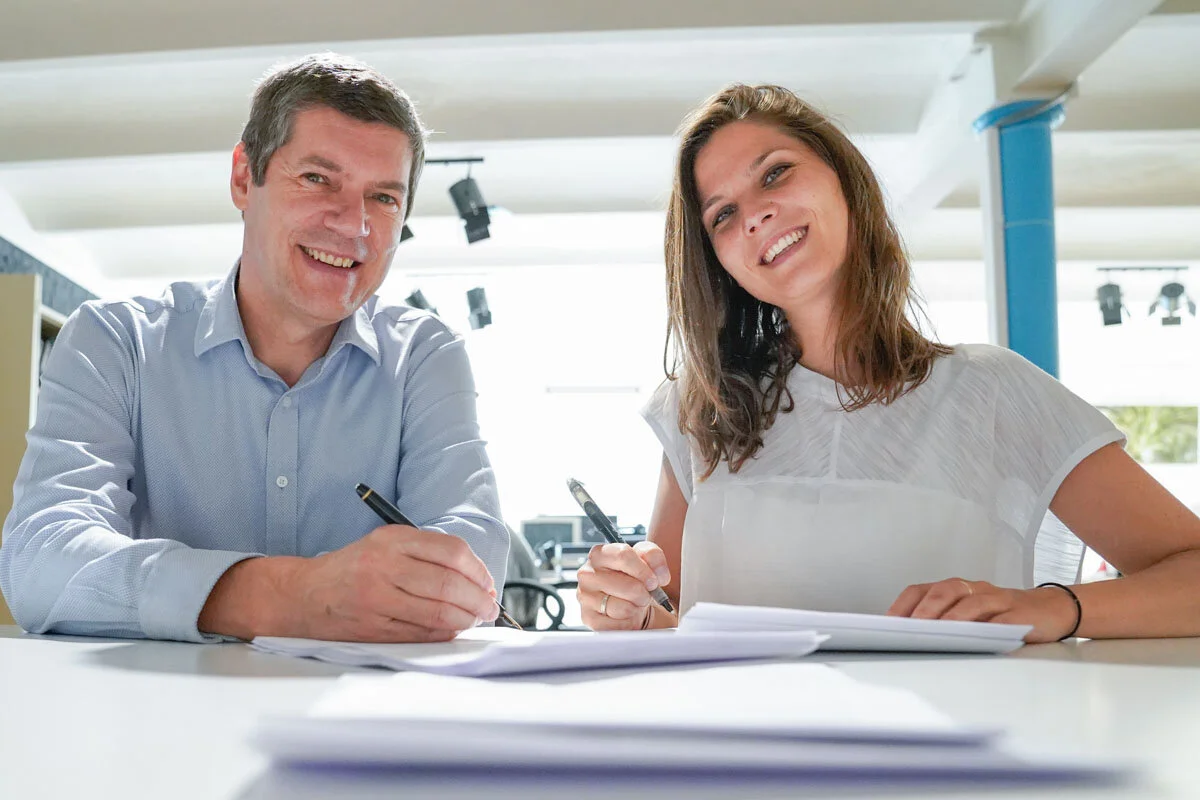
Daïna and Paul
ABOUT HAGUENAU
Haguenau is home to numerous talented photographers, and there are many opportunities to capture striking images there.
Haguenau is a French commune in the Bas-Rhin department, part of the European Collectivity of Alsace. As a departmental sub-prefecture, it forms part of the Grand Est administrative region. This commune is situated in the historic and cultural region of Alsace.
It is the second-largest town in the Bas-Rhin department and the fourth-largest in Alsace, with a population of around 35,000, whilst its urban area has a population of 120,000. The municipality of Haguenau is notable for its very large area (18,259 hectares, making it the largest in Alsace). This territory includes, in particular, a large forest, which forms a distinct break within the Alsace plain. The town is situated in a vast clearing to the south of this forest.
The original name ‘Hagenau’ describes the landscape that can still be found between Soufflenheim and Haguenau: in German, a ‘Haag’ is a small wood, whilst an ‘Aue’ is a landscape of meadows near a river.
Around 1115, Frederick the One-Eyed, the father of Frederick Barbarossa, built a castle on the Île de la Moder (on the site of the present-day care home). It was in the shadow of this ‘Burg’ that Haguenau (the name means ‘the river’s enclosure’) was founded and grew.
The town prospered under Emperors Frederick I Barbarossa and Frederick II, who resided there intermittently until 1250 and granted it significant rights, including Frederick Barbarossa’s charter of privileges in 1164. Richard the Lionheart, then a prisoner of the Emperor, was tried in Haguenau in 1193 and sentenced to pay a heavy ransom. From the end of the 13th century, the Grand Bailiff, the Emperor’s representative in Alsace, held court in Haguenau. Haguenau was also the capital of the Décapole, the confederation of ten towns established in 1354. In 1434, Emperor Sigismund shared ownership of the forest with the town; this arrangement, whereby the forest is jointly owned by the town and the State, remains in force today. An important economic centre – particularly a commercial one – Haguenau was also, until the 16th century, a major cultural hub, notably home to significant printing workshops (Gran, Anshelm, Setzer, etc.). The churches of Saint George and Saint Nicholas, the Chancellery (Alsatian Museum) and the Old Customs House are the most striking remnants of this period of glory and prosperity.
But the Thirty Years’ War ushered in a dark century, with a succession of sieges and occupations, including that by the infamous Mansfeld in 1621–22. The annexation of Alsace by France in 1648 led to tensions between the town and the royal authorities: in 1677, on the orders of Louis XIV, the town was set alight twice and destroyed, and the imperial castle was razed to the ground. From 1715, after the War of the Spanish Succession, Haguenau underwent a genuine renaissance and was rebuilt: it became, after Strasbourg and Colmar, the Alsatian town with the greatest number of 18th-century buildings. From then on, and right up until the 20th century, it became a major centre for marketing agricultural produce from its hinterland (madder in the 18th century, hops in the 19th century), an important garrison town, particularly after 1871, whilst also making the most of the resources of the surrounding woodland. Industrial activities, on the other hand, were scarcely encouraged.
In addition to its many picturesque narrow streets and distinctive atmosphere, Haguenau offers numerous green spaces and attractive walks. The town provides an ideal setting for photographers and for creating unique photo reports that showcase your company, organisation or institution.
Haguenau is a multifaceted town, well suited to photography.
The Communauté d’Agglomération de Haguenau comprises a network of medium-sized towns and rural municipalities, bringing together a total of 36 municipalities.
This region comes to life through the various events that take place throughout the year, as well as the activities and places of interest to be discovered there.
Unmissable historical sites bear witness to the past that Alsace has experienced over several periods, particularly during the Second World War. Several restored buildings are open to the public and offer guided tours.
The Maginot Line, Schoenenbourg Fort, the Casemates, the Musée de l’Abri… but certain sites commemorating Jewish heritage will open their doors to you, allowing you to retrace the history of our region.
We can provide you with a professional photographer in Haguenau whose skills match your requirements for photojournalism.
Some useful links:
The official website of the town of Haguenau
The Facebook page for the town of Haguenau
The Wikipedia page on the town of Haguenau
Please explore our photography services.
Our photographers in the Grand Est region
Institutional photography
Portraits
The mini-planets
Architectural photography
Digital communication